
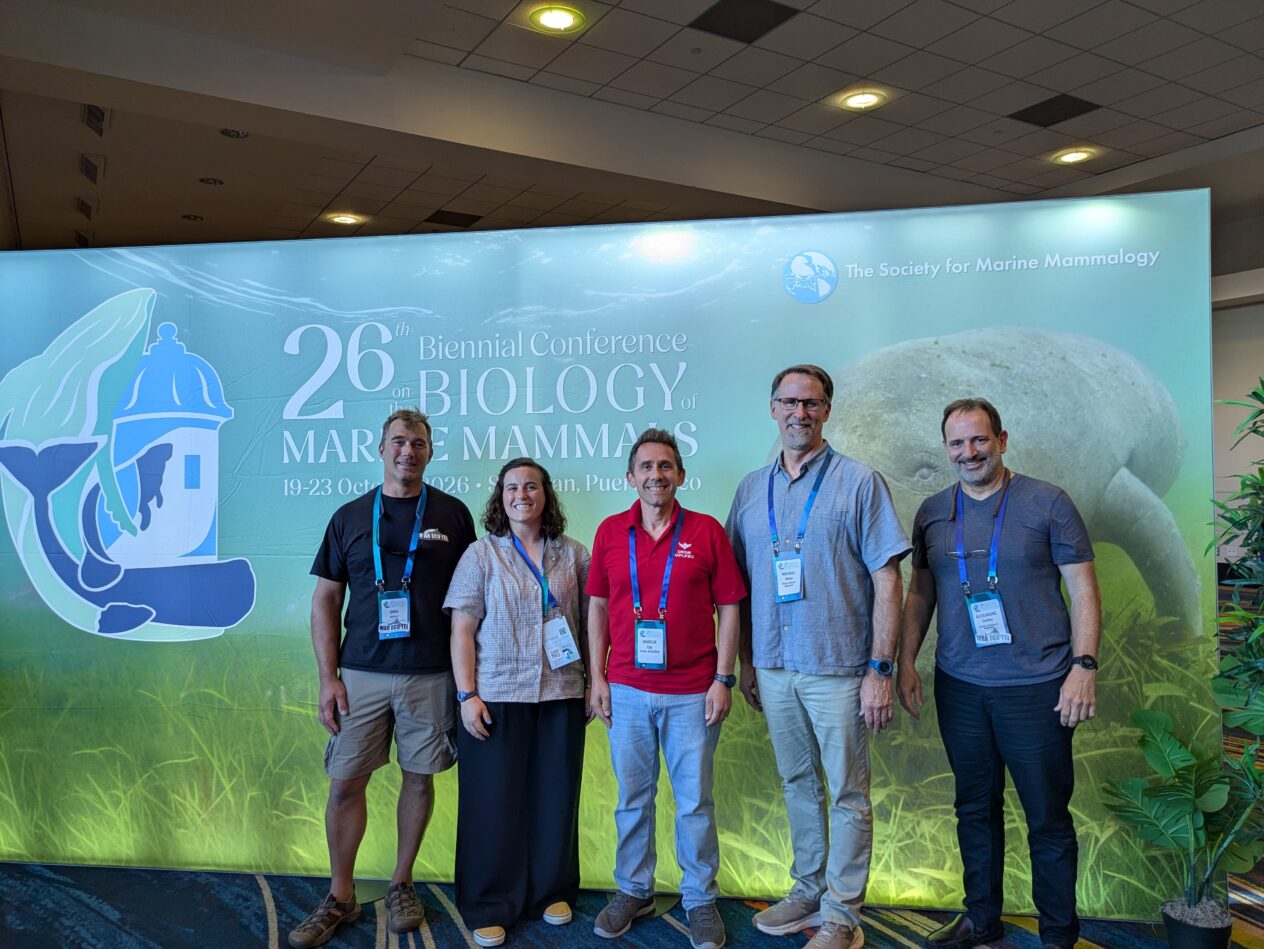
We’re excited to share that we’ve been selected for a Navy SBIR Phase II award under topic N242-097, Unmanned Aerial System for Tag Deployment in Marine Mammal Monitoring. The project aims to improve how researchers monitor marine mammals and understand the effects of Navy sound sources on them.
Why Tagging is so Hard
Anchored biologging tags are among the best tools researchers have for studying cetaceans. They can stay attached for weeks to months, gathering information on where animals go, how they migrate, and how they behave. That data also supports the Navy’s environmental compliance requirements.
Getting these tags attached is another story. They need significant force and precise placement, so today researchers deploy them by hand, using a long pole or from a pneumatic projector from a small boat. That means getting very close to the animal, which puts both the animal and the tagging crew at risk. Cetaceans often move away when a boat gets close, so each deployment can take longer, opportunities are missed, and the chance of harassment goes up.
Drones have already been used to deploy short-duration suction-cup tags, but those systems simply drop the tag and let gravity do the work. Anchored tags need more force and, importantly, accurate placement.
Where Drone Amplified Comes In
Our work focuses on adapting a compact, NDAA-compliant, off-the-shelf drone with a payload that can launch anchored tags remotely. The goal is a system that can take off from and return to a small boat, launch tags with the appropriate speed to attach, and hit small targets accurately. To do that, it has to account for wind and for the movement of both the drone and the animal, using onboard measurements to predict the tag’s flight path. It should also capture imagery with range and location data, and be simple enough to keep operator training and workload low. Down the road, AI and computer vision could help the drone automatically track specific features on an individual animal and assist with targeting.
In Phase II, we’re turning our Phase I work into prototype payloads and hardware. We’ll test how the hardware performs, plan how it fits onto a compact drone, and deliver a prototype to the Government for integration and testing. Any work with live animals will begin only after the required approvals are in place.
Working with the Research Community
The Bigger Picture
This technology isn’t just for the Navy. Agencies like NOAA, the Bureau of Ocean Energy Management, the U.S. Geological Survey, and the U.S. Fish and Wildlife Service all work to understand and protect marine life, and a key goal is making this capability available to the broader research and Navy communities.
We’re proud to be part of this work and look forward to sharing more as the prototype takes shape.
###