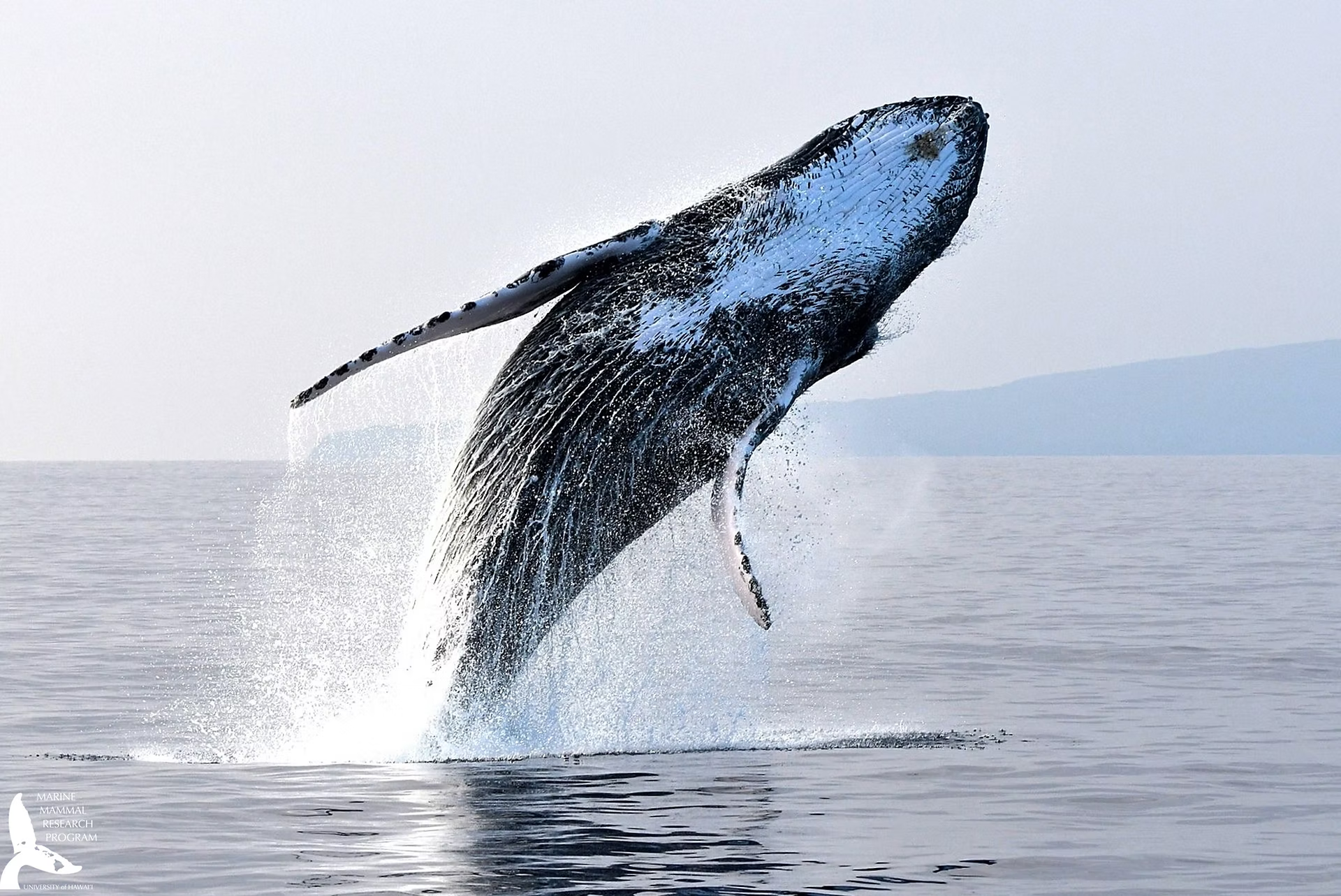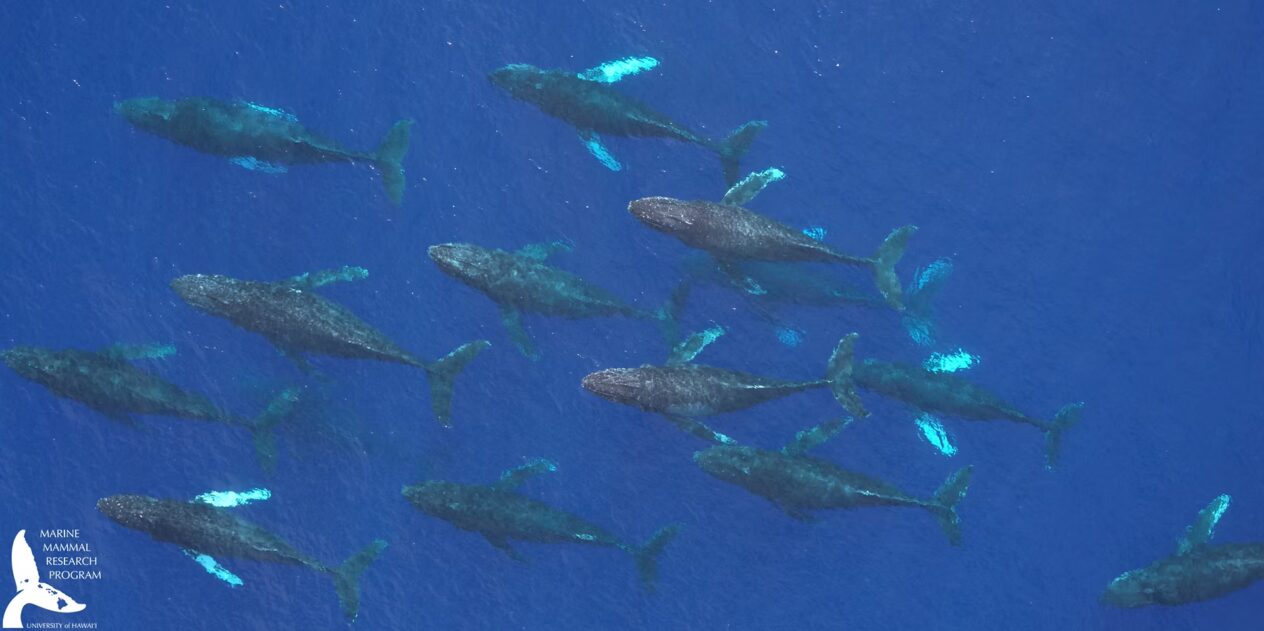

Lars Bejder and his team at the Marine Mammal Research Program at the University of Hawai‘i at Mānoa are measuring that balance, one whale at a time. Working with the Alaska Whale Foundation, they have built what Lars calls the world's largest database on humpback whale health: more than 15,000 drone-based measurements across feeding and breeding grounds over nine years.
The Big Question: A Whale's Energy Budget
Measure from Above, Identify from Behind
On the water, the team needs two basic pieces of information from every whale.
The first is a clean overhead video. The pilot puts the drone above the whale during a slow surfacing to capture a good dorsal view. Stills pulled from that video show how long and how wide the animal is. From there, the team calculates its volume and, from that, its mass.
The second is the whale's identity. As the whale dives, its tail flukes lift out of the water, and every fluke pattern is unique. "That's basically its fingerprint, or its face, for us," Lars said. The boat holds position about 100 yards behind the whale, waits for it to fluke up, and grabs the photo. The team uploads it to Happywhale, an online platform that uses AI to match it against a global catalog of humpback flukes.
The measurements only work if the altitude is right. Lars noted that altimeter readings have to line up with the video to the millisecond, or the height is off and the whole calculation drifts. Linking altimeter data to exact video timing was one of the pieces of feedback his team shared with Drone Amplified as D.A. FLIGHT was built out.

From Velcro to Astro
Drone photogrammetry entered Lars's work about 15 years ago in Australia, led by Fredrik Christiansen, then a postdoc in his lab. The early setup was rough. The team flew Splash drones with ordinary cameras Velcroed on, set to fire every two seconds. There was no live feed, so the pilot couldn't tell whether the drone was even over the whale.
Once they got over that hump, the team says they haven't looked back. Lars pointed to more stable aircraft, slightly longer flight times, and top-notch data quality. "We are extremely happy," he said. Their setup pairs the Astro and its Sony LR1 camera with D.A. FLIGHT, Drone Amplified's ground control app, which the team uses to fly from a moving boat and keep altimeter readings synced to video so every length and width measurement holds up.
The Skill Behind the Sticks
The aircraft is only half of it. Lars's graduate students have logged thousands of flights and become exceptional pilots, and he says that experience matters.
The team flies from a small research vessel, with waves, wind, a moving deck, and animals that do what they want. Pilots launch and catch the drone by hand, using catch handles Drone Amplified designed for this kind of work. They have to read whale behavior to know when to fly and when not to. Above all, if something starts going wrong, the instinct to get the aircraft back safely, for the people on board and the equipment, has to be automatic.
"Just because my 16-year-old daughter just got a driver's license doesn't mean she's a good driver," Lars said. Pilots train for many hours across many conditions before he's comfortable handing them that responsibility.
His advice for researchers bringing drones into their own fieldwork comes down to two things:
Practice until it's second nature. With wild animals, you often get one chance. "You don't want to miss an opportunity," Lars said, so you can't be fumbling with setup when a whale surfaces.
Know your equipment inside and out. Learn some engineering and signal processing. When you're in Antarctica or Alaska and something breaks, you can't always call for help.
What's Next
Lars has a clear wish list, and it's a useful map of where field technology needs to go:
Automated measurements. Today, someone has to click along the outline of each whale by hand to get the contour used for volume. Automating that step would dramatically speed up processing for a dataset this size.
Longer flight time. "Something we always want," Lars said.
Smaller photogrammetry platforms. The Astro is sturdy and capable, but for measurement flights Lars would love something much smaller: cheaper, safer, and easier to launch from a small boat.
The science is moving fast, too. With nine years of measurements on thousands of known individuals, the team can increasingly answer the question they started with: what does a changing ocean cost a whale?
We're grateful to Lars and his team for sharing their work, and we're excited to keep building tools alongside researchers who push them this hard.
The Marine Mammal Research Program’s fieldwork and equipment was funded through the University of Hawai‘i at Mānoa, the US Department of Defense’s Defense University Research Instrumentation Program (N00014-21-1-2249 and N00014-25-1-2027), Office of Naval Research (N00014-25-1-2423), U.S. Navy's Living Marine Resources Program (N39430-25-C-2006), Dolphin Quest, and through Philanthropic donations.
[Permit statement: Images collected under authority of NMFS Permit No. #21476 and #27548]